
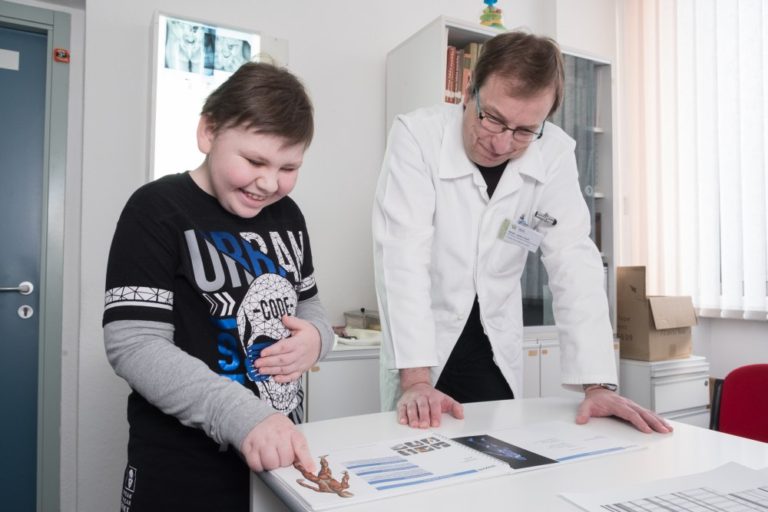
His mother, Iva Jiřenová, emotionally recalls the time when Alex Weber was admitted by a doctor at the Vesna Vasil Janko Children's Hospital: "After seven months, we left the strictly guarded sterile environment of the Motol ICU and went to the hospital, where I no longer had to spray everything with disinfectant." Her then seven-year-old son was transferred to Janské Lázně directly from Motol in Prague, where he underwent intensive treatment after a demanding brain tumor operation.
Alex's diagnosis before the operation was: anaplastic ependymoma of the third degree - a malignant brain tumor with metastasis. "It grew quickly, according to the doctors the tumor grew within five months. For a long time it was impossible to find out anything. Alex was always tired, his eyes hurt, then he started vomiting, in two months he lost 8 kilos and the general practitioner sent him to a psychiatrist, saying that it was due to nerves and that I was an oversensitive mother. Finally, they gave him this shocking diagnosis in Liberec," explains Mrs. Jiřenová.
After a demanding operation in Motol, Prague, Alex and his mother spent two months at the Vesna Children's Hospital in Janské Lázně, returning home nine months after the operation. " We go to rehabilitation at home twice a week, we have to exercise ourselves every day. And we like to come here to Janské Lázně every year. You can always see some progress here and it's getting better and better," his mother praises.
Exercise hurts, but it helps
" In Vesna, MUDr. Vasil Janko took care of us right from the start and we agreed that we would rehabilitate intensively. My son underwent electrotherapy because he was paralyzed on the left side of his body, which was a result of a brain tumor. At the beginning, we practiced the Vojta method, and he also went to hydrotherapy - in the pool, in the jacuzzi," recalls Mrs. Jiřenová. "Now we practice balance exercises for balance, strengthening exercises to strengthen the muscles so that "the body can hold on". And in addition to the prescribed procedures, we also choose from a range of therapeutic massages."
The little patient is regularly treated by physiotherapist Katarína Luptáková. "She knows what to do with me and is very kind to me," Alex always looks forward to her. Katarína Luptáková praises Alex: " I remember Alex when he was first brought to the exercises. Since then, he has come a long way to get to where he is now. His stability is still not 100%, so we are working on it with him. Sometimes it goes easily, other times he has a bad day and then we try something easier. But Alex is a fighter and, above all, a sunshine. After every exercise, he hugs me and waits for the evaluation ," adds the physiotherapist.
"Does it hurt?" I ask Alex. "I just enjoy it. My mom and I have a slogan: Exercise hurts, but it helps."
Step by step for the better
Today marks three years since the biggest turning point in his health began to improve. "Alex is starting to walk on his own, he still needs support, but he is very happy about it. His daily helper is, of course, a wheelchair," shares his mother's joy. At the same time, however, she recalls: "It improved slowly and gradually. Sometimes nothing happened for several months, then suddenly a leap - the progress often only becomes apparent after a long time. I was impatient, but it taught me and my son to accept every small success with joy."
What does mom want?
" The main thing is that we are at least where we are. So far, the oncologists like it, we have to trust them. We go to Motol for check-ups and an MRI every three or four months. Dr. Holub, who operated on Alex, is happy to see him ," says Mrs. Jiřenová. " He saved my life ," adds Alex.
Zdenka Hanyšová Whole
Alex has made great progress since January 2015, when he first received treatment in Janské Lázně in Vesna. From a child who could only turn on his side in locomotion, he is now a boy who can walk independently in terrain for about one kilometer. Of course, this is thanks to his strong will and the endless support of his family, especially his mother.
Unfortunately, treatment is still necessary, including pharmacological treatment. So his condition is affected by both the underlying disease and the side effects of the medication. Therefore, from a rehabilitation perspective, we are still working on improving stability and coordination.
To illustrate the improvement that Alex has managed, I will mention that I presented his case at an international symposium in the section dedicated to the rehabilitation of oncological pediatric patients. In the discussion, a colleague from abroad argued, using my case study, that the results of rehabilitation can be at a high level even in the case of the type of intervention on the central nervous system that Alex underwent. With such a complicated course as Alex's, few people expect this. In other communications (by colleagues from top institutions in the Czech Republic) on this topic, such an optimistic result was not expected.
Vasil Janko, MD
doctor at the Vesna Children's Hospital


